Thursday, October 15, 2015

Thoughtful Thursday: Proactive? or Reactive?

Good Morning Academic Mentors!


I want to take a different angle to today's Thoughtful Thursday. Let's look at one way to think about learning - Proactive vs Reactive vs Inactive. In the moment, proactive learners function much like the growth mindset, but I want to frame this with an eye for study skills and time management.

It is critical to mention that everyone exhibits all three levels of activity in their learning! It's just a matter of which one is more prominent in decisive situations. It's also a matter of growing as much as possible... moving inactive and reactive tendencies towards proactivity.


Inactive Learner



The Inactive learner is just that, inactive. Failed a test? meh. Missed class? meh. Didn't study? meh. Don't have any idea what lecture was about? meh.

This is much more of an issue at the high school level from my experience. That being said, it can crop up in the college level too. If you notice someone going from proactive or reactive to inactive, this might be a sign the student is in distress. For more info on a student in distress, check out this previous blog post.


Reactive Learner


Ah, we have all been there, haven't we? Yes, procrastinating is a part of being reactive, but it isn't the whole thing. Let's take a look at a few characteristics...

  • Accepts things as they are
  • Waits to be 'taught'
  • Waits until a bad grade to work hard in a class
  • Exam studying is done in chunks right before the exam
  • Weeks go by without studying a course because "other courses are keeping me busy"
  • Fixed mindset
So, what can we do to help a reactive learner?
  1. Point out reactive behavior in a kind way.
  2. Point out how a reactive behavior may be causing the student undue stress.
  3. Encourage students of the benefits of proactive learning.

Proactive Learning

Soooooo Bob. What are the characteristics of a proactive learner?

Well, you, here they are!
  • Employs growth mindset
  • Asks questions early
  • Studies every course every day even if an exam is not looming
  • Cramming is not necessary
  • Misunderstandings are uncovered early and in smaller chunks, making them more manageable to overcome
  • Student does extra problems outside of the homework
  • Student seeks out academic mentors / learning support within the first two weeks of the semester.
  • Student consistently attends academic mentoring even if the student needs to study for another course.

So, I ask you this: how can you help your students move from being reactive to proactive? How can we address students' reactivity or inactivity in a respectful way?

Oh, and one way YOU can EASILY help your students become more proactive is by encouraging them to attend the Time & Money Management Workshop on Wednesday, October 28th from noon-1pm at B47 Bascom Hall hosted by yours truly. Your student will be better off for attending and all you have to do is spend 30 seconds encouraging your student! What a great deal!!!!

If you don't watch Curb Your Enthusiasm... it's prettaaaay.... prettaaaaay... prettaaaay good.

Wednesday, October 14, 2015

New Strategies for Better Practice!

Do you or your students feel in a study rut? It's common to feel that way, especially around this time of the semester. We could all benefit from different types of studying and practice!

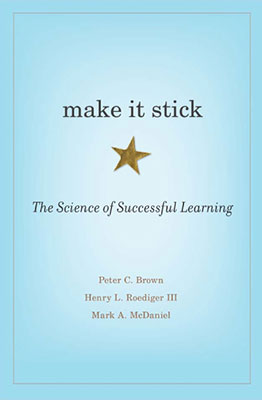
The Lead Academic Mentors are reading the book "Make It Stick" which discusses several types of practice that will boost comprehension and recall. Here are four new strategies that we designed to use these different types of practice. Try them out in your sessions, and let us know in the comments how they worked out!


Monday, October 12, 2015

Mentor Monday: Ryan Raut!

Today we're highlighting Ryan Raut, who's been with CAE for six semesters! He holds the record for being the most experienced Lead Academic Mentor out of the group, as he's been a LAM for Psych 202 for four semesters.


Please introduce yourself, and include your favorite quote, flavor of ice cream, and fall activity. 
Hey everyone! I'm Ryan and I'm a senior here at UW. I'm studying neurobiology and psychology and plan on going to graduate school for neuroscience.
Favorite quote: "If I don't scream, if I don't say something, then no one's going to say anything." -Kanye West
Favorite ice cream flavor: Fudge brownie cookie dough 
Favorite fall activity: Playing in leaf piles 

Q: What is your favorite strategy card/activity/game to play to help solidify information in your sessions? 

A: My favorite activity is the one- (or two- if it's a cool topic) minute paper. Explaining concepts in your own terms is a great way to solidify information, and most importantly, this activity helps students gauge how well they know a topic. I like to use this at the end of a session, and it's very low pressure (I don't see the result) so students don't mind it.

Q: Do you have any advice for new Academic Mentors?

A: Have fun with it! Learning doesn't have to be boring. Your goal is to help your student understand concepts and achieve at a high level -- there's a ton of flexibility in how you get there.  

Q: How do you stay organized? 

A: About halfway through college, I started making use of my phone as an organizational tool. I keep a "to-do today" list, a "to-do when I find the time" list organized in order of priority, and I put every event, meeting, deadline, or exam into my phone's calendar. There's no way I could stay on top of things nowadays without this approach!


Q: What's your favorite study spot on campus? 
The Computer Sciences building -- happy medium between the depressing Memorial Library and the overly social College Library. And open until 1 am every day of the week! 

Thanks, Ryan! Hope everyone has a great week! 

Thursday, October 8, 2015

Thoughtful Thursday: Using Humor to Enhance Learning


It's another Thoughtful Thursday, and that means tomorrow is Friday, which means the day after that is the weekend! What an exciting day of the week! I hope you all are finishing strong so you can have a restful and/or productive weekend.

Think about the best learning environment you've ever been a part of. Close your eyes and bring those memories to the front of your thought. What characteristics do you see? (feel free to comment them!)

I suppose that you have thought of at least a few of the following:

  • Safe
  • Focused
  • Lighthearted 
  • Good community
  • Fun
Researchers have been looking for a long time how to make learning environments produce more learning. One way to achieve the qualities of a good learning environment is to use humor


Why Humor (can) Help Learning

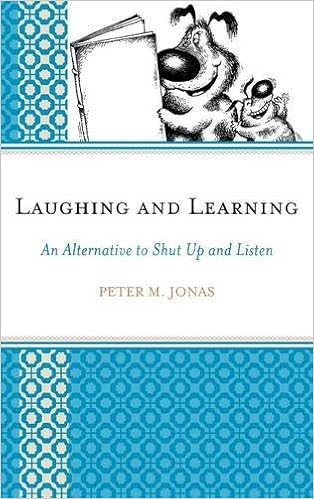
Pictured above is the book Laughing and Learning: An Alternative to Shut Up and Listen by Peter Jonas, PhD at Cardinal Stritch. His book talks about the benefits of humor in an educational setting: 
  • it improves culture
  • it improves instruction
  • it reduces tension and stress
  • promotes creativity and divergent thinking
  • can help adjust behavior
  • helps teachers and facilitators enjoy their work
I think we can agree with most of these points as intuitive, but Peter Jonas does a nice job weaving in research and, of course, some humor in his book. Let's look a little more at why it helps instruction (learning).

Imagine you are taking a nice walk in a forest in northern Wisconsin. You notice a nice patch of Raspberries, and go down to take a mid-hike snack break. Suddenly, you notice on the other side of this bush is a giant black bear, and you are eating its dinner! It roars at you, and, without thinking, you scream and run. Your breathing is rapid, your pupils dilate, and you lose peripheral vision. You turn around and realize the bear never chased you, and you hide behind a tree. You're now nauseous, shaking, and tense.


Now, imagine that I start telling you about the difference between Alpha and Beta carbons or how to find the limit of rational polynomial functions. This won't work out that well, will it? Why not?

Your amygdala has told your hypothalamus to get your pituitary gland ready for "fight-or-flight response." Among many reactions, your brain begins making decisions based on your short-term survival, purposefully filtering out any information that might distract you from your threat. Instead of learning Organic Chemistry or Calculus, you are focused on the bear.


Okay, let's swap a bear for a difficult class. For many students, the classroom can be a stressful environment. They have to balance expectations and their futures, and their work in the class will make or break their lives (or so they think). What this does is creates a very similar fight-of-flight response - which makes the amygdala very angry and stops learning. For some students it can be test anxiety, getting nervous when called upon in class even though they know the answer, or even full blown panic attacks. The body is screaming "get me out of here, I am not safe!"


In comes humor! Humor reduces stress and relaxes the amygdala - helping the brain get ready to learn. This is very important when we talk about they type of humor that needs to be used.


Research & When Humor Doesn't Work

There are forty years of research regarding humor and learning, and that research was summarized four years ago by Banas, Dunbar, Rodriguez, and Liu. And THIS summary was summarized by Maryellen Weimer, PhD in this Faculty Focus article. Take 5 minutes to check it out!

Based on 40 years of research, here are the limitations of humor in education:

  • Humor on tests has no evidence for impact (neither helping nor hurting - 11 studies have been done)
  • Humor that is forced and unnatural is not beneficial.
  • From the article above: “But not all the functions of humor are positive. If humor is used divisively or to disparage others, it weakens group cohesion. Humor has negative impacts when it is used as a means of control. For example, given the power dynamic in the classroom, it is highly inappropriate for instructors to target students by making fun of their ignorance or beliefs.”

This last point is critically important! Humor is beneficial when it disarms people's stress and brings people together! When humor is used to tear people down in any way, it makes learning more difficult by making the amygdala feel threatened. This is why it is very important to address & correct jokes that are bigoted or harmful.

Research & When Humor Best Enhances Learning

The rule of thumb with humor is that teachers and tutors need to laugh with, not at, students! Here is what we know works best with students.

  • Student-initiated humor that does not distract from the content or disparage others
  • Humor that relates to material students are learning and illustrates a point

    • From Maryellen Weimer's blog post: “Finally, if the goal is to use humor to increase learning and retention of course material, then use the humor to illustrate a concept just taught. This way, the humor helps students remember the material, and material can’t be learned unless it is remembered. And one thing about humor and learning is well-supported by the research: Humor positively affects levels of attention and interest. It’s a way to keep students engaged and involved with the course material. So if the concept is an important one, consider incorporating some humor.”
  • Perhaps have students come up with jokes or humorous ideas to remember difficult concepts - don't take the burden of generating ideas on your own!
So, go forth, and implement humor in your sessions and enhance learning! You'll enjoy it, your students will enjoy it, and you all will learn more!

laughing-patrick-spongebob-spongebob-squarepants-favim-com-236895.gif (500×344)


Please comment with how you have or will use humor in your sessions. Also talk about a learning experience where humor was used well!


Monday, October 5, 2015

Mentor Monday: Sheena Singh!

This Mentor Monday post features Sheena, a new Lead Academic Mentor for Chem 103.


Q: Hi, Sheena! Please give us a quick introduction of yourself.

A: I'm Sheena Singh, a Neurobiology major. Future goals: Medical School, Favorite quote: "I don't want to end up having simply visited this world." -Mary Oliver


2) How did you become involved in Academic Mentoring, and in what capacity are you involved now?


A: I became involved in academic mentoring because I was introduced to the program through a current academic mentor (Monica) and she inspired me to get involved. I am currently a Lead Academic Mentor in Peer Learning. 

Q: What is your favorite strategy card/activity/game to play to help solidify information in sessions? 

A: I really like using the Grab Bag because I think that it's a fun way to introduce variety into sessions. I also think that it's nice for students to have something to physically hold on to instead of just reading problems off of a board. 

Q: What's your favorite part about CAE, academic mentoring, or being a Lead? 

A: My favorite part of CAE is the way that Aygul and Bob train the academic mentors. I have found all of the information on learning and the best ways to help students retain information incredibly useful, not only in my sessions but in my personal academic life as well. By providing academic mentors and leads with a variety of information and resources, it ensures that the sessions are a success. 

Q: What's your favorite way to relax outside of school and extracurriculars? What do you really enjoy doing? 

A: My favorite way to relax outside of school is getting outside and doing something active. Whether it be paddle boarding on lake Mendota (which I love!) or going to an apple orchard when the weather gets a little bit chillier, I think it is very important to get outside. I find that nature and exercise is the best way to clear the mind. :) 


Thanks so much! Look forward to reading our next Mentor Monday next week, where we'll highlight an Academic Mentor who has been tutoring with us for several semesters. 

Friday, October 2, 2015

Thoughtful Thursday: Tools to Help Students Remember! (And some Language Resources!!!)

Well the title is a lie, as GLaDOS from Portal would appreciate. Sorry that I was sick yesterday and missed the post!


Anyways, welcome to the second weekly, though belated, Thoughtful Thursday! 


How often are we like 99% of Leonard Shelby of Memento, who couldn't form any new memories. Our brains are very good at filtering out new information and sorting it without us even recognizing (think implicit bias)! Therefore when we are learning, it's important to "trick" our brain into thinking that incoming information is important.

Image result for memento
Great movie, BTW


See Aygul or Bob if 
you're interested in 
getting a copy!
"But Bob, how can I trick my brain?" - You ask. In comes Psychology!

The Lead Academic Mentors are working through a book right now called Make It Stick, which goes through the proven science of successful learners. The book talks about two ideas: Illusions of Knowing, and Effortful Retrieval. Let's take a look at both really quickly. Oh, and for your foreign language junkies, check out Fluent Forever, a book that is similar to Make It Stick but focuses on language!

Illusions of Knowing: When you FEEL like you're learning, but you actually aren't. This is caused when an activity is comfortable, but does not actually cement any learning. Examples are:

  • Massed Practice
  • Reading & Rereading
  • Looking at your notes
These feel beneficial at the time, but then when the test comes, the learning is gone!


Instead, focus on Effortful Retrieval. This is the idea that learning is much more than exposure! Not only does information have to enter your brain, but it has to be deemed as worthy information to store. In order to do this, you need to pull the information out in intervals! Some examples are:

  • Practice for 20 minutes 3 times a day instead of 7 hours all at once.
  • Read, take notes, make questions, and quiz yourself in intervals
  • Use flash cards, or Quizlet.com , or Anki
    • (What's great about Quizlet and Anki is that your cards are 4 or 5 dimensional, with pictures and sound!)
  • Play games! Make Jeopardy games online, or get into a group and play a Kahoot! 
  • Practice retrieving items that are not as easy!

Soon enough, with the right type of practice, you and your students will be acing every test!


Please comment with how you use effortful retrieval with your students and your own studying! How has it helped you master content?


Monday, September 28, 2015

Mentor Monday: Featuring Nate Cudworth

Welcome to our second Mentor Monday! This week we're highlighting Nate Cudworth, a new Lead Academic Mentor for Math 221. 

                                                                       
Q: Can you please give us a quick introduction of yourself? 

A: My name is Nate Cudworth, and I'm a Nuclear Engineering-Radiation Sciences major. My future goals somehow include a position of leadership in my career field. What that exactly is, I do not know, but I want to lead a group of people to accomplish a worthwhile goal that can help others. 

Q: How did you become involved in Academic Mentoring, and in what capacity are you involved now? 

A: I was searching online for tutoring opportunities through the university and found CAE. I applied and was accepted in the fall of 2014 as an academic mentor. This summer I accepted a position as a lead academic mentor and am currently working with a group of students in Math 221. 

Q: What is your favorite strategy card/activity/game to play to help solidify information in sessions? 

A: My favorite activity to do with my students is a Socratic seminar scenario where I give the students problems to do in small groups. Then, I have them present their work to the group as a whole and explain their thought processes and methods to show their own understanding and allows others to see another point of view on the problem. 

Q: What's your favorite part about CAE, academic mentoring, or being a Lead? 

A: My favorite part of being a lead is the group setting. It follows along with my future goals in wanting to lead a group of people toward a common goal. The exposure now can help a lot later on. 

Q: Do you have any advice for academic mentors or students around midterms? 

A: If I have one piece of advice for students and mentors alike, it's spread out your studying over a week or two so you don't cram the night before and stress yourself out over material that would be better studied in short spurts. 

Q:  What is one way you relax and feel on top of things when assignments, exams and extracurriculars start to pile up? 

A: One way I try to relax and relieve stress is playing basketball at the rec facilities on campus. An hour and a half on the court can do a lot for my physical and mental health during stressful times in the semester. Your brain needs a well-deserved break sometimes. 

Thanks, Nate! Leave any comments below, as well as nominations for upcoming Mentor Mondays. Thanks for reading, everybody!