It's another Thoughtful Thursday, and that means tomorrow is Friday, which means the day after that is the weekend! What an exciting day of the week! I hope you all are finishing strong so you can have a restful and/or productive weekend.
Think about the best learning environment you've ever been a part of. Close your eyes and bring those memories to the front of your thought. What characteristics do you see? (feel free to comment them!)
I suppose that you have thought of at least a few of the following:
- Safe
- Focused
- Lighthearted
- Good community
- Fun
Researchers have been looking for a long time how to make learning environments produce more learning. One way to achieve the qualities of a good learning environment is to use humor
Why Humor (can) Help Learning
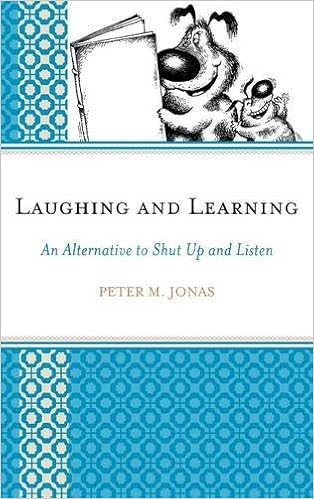
 Pictured above is the book Laughing and Learning: An Alternative to Shut Up and Listen by Peter Jonas, PhD at Cardinal Stritch. His book talks about the benefits of humor in an educational setting:
 - it improves culture
- it improves instruction
- it reduces tension and stress
- promotes creativity and divergent thinking
- can help adjust behavior
- helps teachers and facilitators enjoy their work
I think we can agree with most of these points as intuitive, but Peter Jonas does a nice job weaving in research and, of course, some humor in his book. Let's look a little more at why it helps instruction (learning).
Imagine you are taking a nice walk in a forest in northern Wisconsin. You notice a nice patch of Raspberries, and go down to take a mid-hike snack break. Suddenly, you notice on the other side of this bush is a giant black bear, and you are eating its dinner! It roars at you, and, without thinking, you scream and run. Your breathing is rapid, your pupils dilate, and you lose peripheral vision. You turn around and realize the bear never chased you, and you hide behind a tree. You're now nauseous, shaking, and tense.
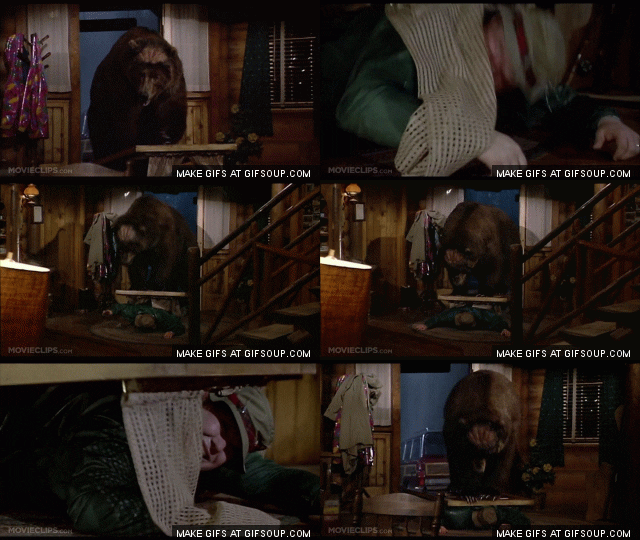

Now, imagine that I start telling you about the difference between Alpha and Beta carbons or how to find the limit of rational polynomial functions. This won't work out that well, will it? Why not?
Your amygdala has told your hypothalamus to get your pituitary gland ready for "fight-or-flight response." Among many reactions, your brain begins making decisions based on your short-term survival, purposefully filtering out any information that might distract you from your threat. Instead of learning Organic Chemistry or Calculus, you are focused on the bear.
Okay, let's swap a bear for a difficult class. For many students, the classroom can be a stressful environment. They have to balance expectations and their futures, and their work in the class will make or break their lives (or so they think). What this does is creates a very similar fight-of-flight response - which makes the amygdala very angry and stops learning. For some students it can be test anxiety, getting nervous when called upon in class even though they know the answer, or even full blown panic attacks. The body is screaming "get me out of here, I am not safe!"

In comes humor! Humor reduces stress and relaxes the amygdala - helping the brain get ready to learn. This is very important when we talk about they type of humor that needs to be used.
Research & When Humor Doesn't Work
There are forty years of research regarding humor and learning, and that research was summarized four years ago by Banas, Dunbar, Rodriguez, and Liu. And THIS summary was summarized by Maryellen Weimer, PhD in this Faculty Focus article. Take 5 minutes to check it out!
Based on 40 years of research, here are the limitations of humor in education:
- Humor on tests has no evidence for impact (neither helping nor hurting - 11 studies have been done)
- Humor that is forced and unnatural is not beneficial.
- From the article above: “But not all the functions of humor are positive. If humor is used divisively or to disparage others, it weakens group cohesion. Humor has negative impacts when it is used as a means of control. For example, given the power dynamic in the classroom, it is highly inappropriate for instructors to target students by making fun of their ignorance or beliefs.”
This last point is critically important! Humor is beneficial when it disarms people's stress and brings people together! When humor is used to tear people down in any way, it makes learning more difficult by making the amygdala feel threatened. This is why it is very important to address & correct jokes that are bigoted or harmful.
Research & When Humor Best Enhances Learning
The rule of thumb with humor is that teachers and tutors need to laugh with, not at, students! Here is what we know works best with students.
- Student-initiated humor that does not distract from the content or disparage others
- Humor that relates to material students are learning and illustrates a point
- For example, for me learning about microaggressions, this video was very helpful to cement the learning: https://www.youtube.com/watch?v=KPRA4g-3yEk
- From Maryellen Weimer's blog post: “Finally, if the goal is to use humor to increase learning and retention of course material, then use the humor to illustrate a concept just taught. This way, the humor helps students remember the material, and material can’t be learned unless it is remembered. And one thing about humor and learning is well-supported by the research: Humor positively affects levels of attention and interest. It’s a way to keep students engaged and involved with the course material. So if the concept is an important one, consider incorporating some humor.”
- Perhaps have students come up with jokes or humorous ideas to remember difficult concepts - don't take the burden of generating ideas on your own!

Please comment with how you have or will use humor in your sessions. Also talk about a learning experience where humor was used well!


Great to see a post on the learning benefits of humor! I like to use humor to come up with absurd examples that students have a hard time forgetting...
ReplyDeleteBut seriously, I've found that students really benefit from a laid back environment, which can be formed through humor (although, admittedly, I've never compared this with a very formal, serious session -- not really my personality). I know the post talks about being wary of forced humor, but at the same time, this can also be pretty funny for your students! Of course, they'll probably be laughing AT you and your terrible jokes, but if you are able to laugh at yourself then this can still be effective in setting the tone for a relaxed session where students feel safe and can focus on learning.
-Ryan Raut
DeleteThis is so fun! I love it. I really enjoy cracking nerdy chemistry jokes at our sessions. I also like coming up with funny mnemonics to help students remember random reactions or other facts. I think that it's so cool that there's a lot of research backing it up, and I can't wait to continue using it in sessions!
ReplyDelete