
Anyways, welcome to the second weekly, though belated, Thoughtful Thursday!
How often are we like 99% of Leonard Shelby of Memento, who couldn't form any new memories. Our brains are very good at filtering out new information and sorting it without us even recognizing (think implicit bias)! Therefore when we are learning, it's important to "trick" our brain into thinking that incoming information is important.
 |
| Great movie, BTW |

  |
See Aygul or Bob if
you're interested in
getting a copy!
|
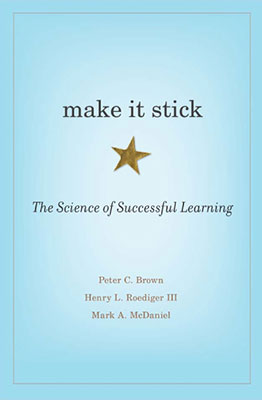
The Lead Academic Mentors are working through a book right now called Make It Stick, which goes through the proven science of successful learners. The book talks about two ideas: Illusions of Knowing, and Effortful Retrieval. Let's take a look at both really quickly. Oh, and for your foreign language junkies, check out Fluent Forever, a book that is similar to Make It Stick but focuses on language!
Illusions of Knowing: When you FEEL like you're learning, but you actually aren't. This is caused when an activity is comfortable, but does not actually cement any learning. Examples are:
- Massed Practice
- Reading & Rereading
- Looking at your notes
These feel beneficial at the time, but then when the test comes, the learning is gone!

Instead, focus on Effortful Retrieval. This is the idea that learning is much more than exposure! Not only does information have to enter your brain, but it has to be deemed as worthy information to store. In order to do this, you need to pull the information out in intervals! Some examples are:
- Practice for 20 minutes 3 times a day instead of 7 hours all at once.
- Read, take notes, make questions, and quiz yourself in intervals
- Use flash cards, or Quizlet.com , or Anki
- (What's great about Quizlet and Anki is that your cards are 4 or 5 dimensional, with pictures and sound!)
- Play games! Make Jeopardy games online, or get into a group and play a Kahoot!

- Practice retrieving items that are not as easy!
Soon enough, with the right type of practice, you and your students will be acing every test!



Please comment with how you use effortful retrieval with your students and your own studying! How has it helped you master content?

I practice effortful retrieval by making up potential exam questions from lecture slides, and I use this technique with my students by playing speed games for verb conjugation and by creating fill in the blank questions with essential verb and vocab words. After reading this post, I plan to use Kahoot as well. I can tell a difference from when I simply reread my notes because I am forced to recall the information that I have already learned, and not only read information from the professor.
ReplyDeleteWe go over a concept, and then practice it using examples. Usually I write out sentences for my student to translate, and those sentences require him to apply multiple concepts he's learned, so by doing that he is retrieving past information and combining it with what he just learned. Also, I think reviewing what was covered at the end of a session is really helpful for the student, because he/she has the opportunity to verbalize (retrieve) the information again. I also use Jeopardy and quizlet, but I personally like writing my own notecards because writing really gets the information cemented into my brain.
ReplyDeleteAs I am studying I always trying to utilize effortful retrieval via mnemonic devices. Psychology is one of my majors, so I love to use the science of the brain to facilitate my learning. It has been shown that foraging connections in your brain increases memory as various parts are being used in the storage of facts. By creating and rehearsing these mnemonic devices, I create more connections and (hopefully) increase my learning (the fundamental goal behind facilitated learning!!). I utilize this approach in sessions with my students, by asking them to create their own mnemonic devices, so that they can also benefit by this augmentation of connections! Occasionally I will give them ones that I used in the past, but Im sure this is not as beneficial, as creating your own connection is probably more helpful in the long run. Go psychology! (:
ReplyDelete